
 J. M. Barrie wrote Nana as a Newfoundland and modeled her on his own Landseer Newfoundland, Luath. A century of artists has interpreted her in styles as varied as their creativitiy would allow, each conveying some of Nana's character and personality in their work.
Across the plates examined here, from Woodward in 1907 to Hutton in 2015, the book illustrators drew Nana as a Newfoundland, in one of two coats. British artists and most recent editions follow Luath's white and black Landseer pattern. The American editions of 1950 to 1987, by Unwin, Hyman and Hildebrandt, show the solid black dog that was more prevalent in the breed, despite photographs showing Barrie's Luath to be a white and black.
The one real outlier is Disney. The 1953 film recast Nana as a red-and-white Saint Bernard, and that image dominated popular culture for a generation of films and merchandise. The book illustrators never really followed it, and recent editions have returned firmly to Barrie's dog.
Barrie's source: Porthos and Luath
Barrie owned two large dogs in succession, and both matter to this story.
• Porthos, a Saint Bernard, was the first. He walked with Barrie in Kensington Gardens when Barrie met the Llewelyn Davies boys and appears in The Boy Castaways.
• Luath, a white-and-black Newfoundland, came next, named after a dog in Landseer's painting Twa Dogs. Luath was the model for Nana's stage costume.
Mary Ansell, Barrie's wife, settled the question in her 1924 memoir Dogs and Men: Porthos could never have made a Nana, but Luath was born one.
 Luath arrived as a sickly puppy and grew into a strong dog devoted to children. One afternoon he went to the Theatre Royal, Drury Lane, during a run of Peter Pan and took a stage call with Peter at the end of the nursery scene. After that he was something of a celebrity in Kensington Gardens, where the nannies let him bathe in the Round Pond, which was off limits to dogs. He loved motoring and London's shops, and more than once Mary had to bail him out of the police station, at a shilling a time, for stealing legs of mutton from butchers. When the Barries divorced, Mary kept Luath. He died of old age and was buried in the paddock at the end of her garden. (Nick Waters, The Newfoundland Heritage and Art, 2006, drawing on Ansell's Dogs and Men) Joe Stetson's 1956 Newfoundland Club of America anthology dates his death to 1917.
The Stage 1904
Arthur Lupino played Nana in a costume closely modeled on Luath. He studied the dog at Barrie's home and borrowed specific behaviors, such as banging a paw on the floor. Barrie later recalled that Luath once stood in for the actor at a matinee and the audience did not notice. (Scene4)
The role became a tradition of its own. According to Stetson, Nana was always played by a man, with one exception: during the First World War, when the regular actor was away, his wife took the part. Stetson adds that Nana reached her largest audience in the televised Mary Martin production, played by Norman Shelley. (Joe Stetson, ed., This is the Newfoundland, 1956) Carol Cooper and Bill Mainman find the custom curious, since few characters are more feminine than Nana, with her insistence on bath-time. (The Newfoundland, Newfoundland Club UK, 2010)
The Novel 1911
Peter and Wendy is unambiguous. Chapter 1 calls Nana "a prim Newfoundland dog."
The Porthos connection is real. Waters records that Porthos, originally named Glen, was bred in Switzerland and chosen from the litter while the Barries were honeymooning in Lucerne in 1894, and that he shared many of the early Kensington Gardens adventures with the Llewelyn Davies boys. Waters even grants that enthusiasts of both breeds claim Nana with some credibility. (Waters, 2006) Porthos is the thread Disney later pulled when it recast her. But Nana herself, as Barrie wrote, costumed and published her, was always Luath.
Illustrator by illustrator
The single best predictor of how an artist draws Nana is what they worked from: Barrie's novel, the stage production, or the Disney film. The fair test for each Nana has three parts: colour (Landseer pattern or not), structure (the Newfoundland's broad skull, short muzzle, heavy bone and low-carried tail), and fidelity to what Barrie has her do.
Alice B. Woodward, The Peter Pan Picture Book (1907)
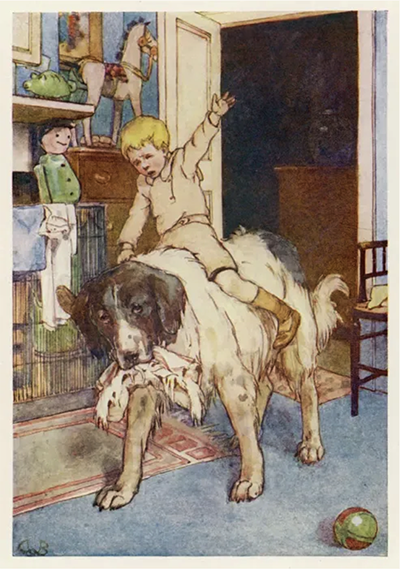 Woodward illustrated Daniel O'Connor's retelling of the play, and her characters wear the elaborate theatrical costumes, so her Nana descends from Lupino's Luath-based suit.
Alice Bolingbroke Woodward (1862–1951) was born in Chelsea, the fourth of seven children of Henry Woodward, Keeper of Geology at the Natural History Museum. By her late teens she was drawing for her father's lectures, which paid for training at the South Kensington and Westminster schools of art and the Académie Julian in Paris. (Bushey Museum) She became one of the first serious palaeoartists: her Iguanodon reconstructions ran in the Illustrated London News in 1895, and her plates for Henry Knipe's Nebula to Man (1905) and Evolution in the Past (1912) were prized for scientific accuracy. (University of Birmingham; Bristol Palaeomedia) She signed her children's work with a butterfly monogram, the mark in the corner of the Nana plate, and her scientific work with her full name. (Wikipedia) Her Peter Pan Picture Book had 28 colour plates and was the first illustrated version of the story. (Bushey Museum) A woman who reconstructed dinosaurs from bones knew how to give an animal real skeletal weight, and it shows in her Nana.
"Michael Riding Nana to Bed" O'Connor's text has Nana fetch Michael for bed and come back with him astride her back. Woodward sets it in a lived-in nursery of soft watercolour over ink: a rocking horse and toy soldier on the shelf, a ball on the floor, a towel in Nana's mouth, and a doorway opening onto a dark hall that quietly hints at the night to come. She is big and heavy-boned, with a broad, domed head, large paws, a low feathered tail and a white coat with a dark head and patches. Michael looks properly small on her back. She also plods with her head down, more patient beast of burden than Barrie's prim professional.
Flora White, Peter Pan's A.B.C. (1913)
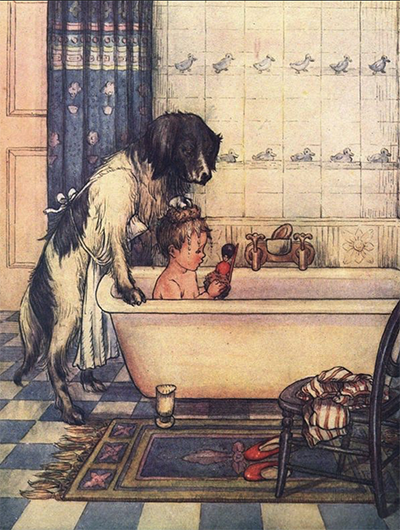 Twenty-six colour plates, one per letter, published by Henry Frowde and Hodder and Stoughton. White also followed the stage costumes. Her plate of Nana bathing one of the children stayed in print through a later OUP edition.
About the artist. Flora White (1878–1953) was an English artist best known for postcards of nursery rhymes and fairy tales. Her children have a sweet, kewpie-doll quality, and she was prolific in the postcard trade that flourished before the First World War. Some sources date Peter Pan's A.B.C. to 1916, but the first edition appeared in 1913. Little else is documented about her life. The postcard background explains the plate: a single, self-contained, charming vignette, built to be read at a glance.
"Nana Bathing a Darling Child" Openly theatrical, this Nana stands upright on her hind legs at the tub, wearing a long white apron tied in a bow, and washes the child's hair with one paw while the child clutches a toy. That human posture is the stage costume made visible: this is how an actor in a dog suit would play the scene. The surroundings are charming and exact: duck-patterned tiles, a checkerboard floor, red slippers by the bath mat, a towel waiting on the chair. Nana's colouring is clearly Landseer, black head and patches on white. White's real contribution is the apron. It shows that dressing Nana as a uniformed servant was a pre-Disney stage tradition, so the 1953 nurse's cap had roots in it. It is also the gentlest image of Nana's competence: she is plainly better at bath-time than any nursemaid.
F. D. Bedford, Peter and Wendy (1911)
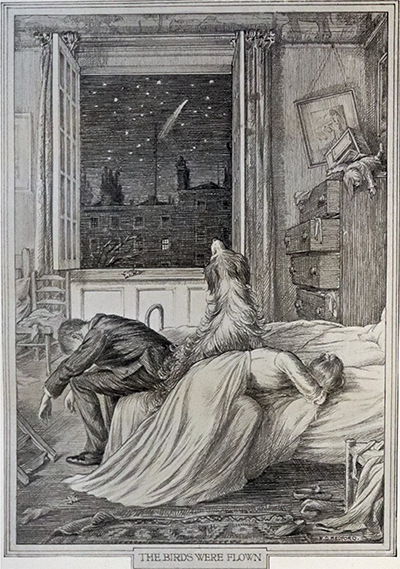 The authorized first edition, with 12 plates and a pictorial title page. Bedford's style leans Pre-Raphaelite. Barrie inscribed a copy to Hilda Trevelyan, the first Wendy, so this is the edition the author handled and endorsed.
Francis Donkin Bedford (1864–1954), a solicitor's son born in Notting Hill, trained first as an architect. He was articled to the church architect Sir Arthur Blomfield, set up practice in 1888 and became an associate of the Royal Institute of British Architects, but built little and turned to painting and illustration. Between 1890 and 1931 he illustrated about fifty books, exhibited at the Royal Academy from 1892 to 1949, and joined the Art Workers Guild in 1901. He also painted a bird's-eye view of Kensington Palace and Gardens, Peter Pan's home ground, around 1910. The architect's training is all over "The Birds Were Flown": the perspective, panelling, window frame and ransacked chest of drawers are drawn with more conviction than the dog.
"The Birds Were Flown" This is the most dramatic Nana in the set and the only one that gives her grief rather than comedy. Bedford stages the empty nursery like a tableau: Mr. Darling slumped and broken, Mrs. Darling collapsed across the bed, drawers ransacked, leaves on the floor, a comet streaking past the open window. Nana sits between them with her head thrown back, howling at the night sky. That rising diagonal from her muzzle to the window is the compositional spine of the picture; she voices what the parents cannot. The dense cross-hatching is superb. The dog itself is not. Her long, silky, feathered coat, narrow tapering muzzle and slim neck read as a rough collie or setter, not a Newfoundland. Bedford took the emotion of Barrie's Nana seriously and the breed hardly at all.
Gwynedd M. Hudson, Peter Pan and Wendy (1931)
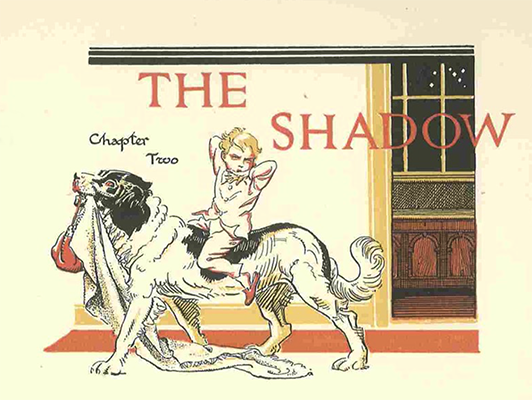 Twenty-one colour plates in Art Deco style, with hand-lettered captions and running vignettes. Like Bedford, Hudson worked from the novel, not the stage.
About the artist. Gwynedd M. Hudson (c. 1881–c. 1935) studied at the Brighton School of Art and worked as a figure painter, illustrator and poster artist. She exhibited at the Royal Academy around 1912 and is best known for her Peter Pan and Wendy and a lavish Alice's Adventures in Wonderland. Her Peter Pan also reached a wide audience through a cheaper edition for Boots' circulating library. The poster artist explains the plate: flat colour, bold silhouette and lettering designed to work at a distance, with anatomy a lower priority.
"The Shadow" A beautifully designed page: flat red, ochre and black, a hand-lettered title that the window frame cuts through, and a witty literal reading of the chapter, with Nana carrying Peter's shadow in her mouth like a limp sheet of laundry while a child rides her back. The colour is unmistakably Landseer: black head, black saddle, white body. Hudson clearly knew the Newfoundland convention. The structure belongs to another dog entirely: long thin legs, a deep tuck-up, a narrow head with a red eye and a tail curled tight over the back like a spitz. Deco favours line over mass, and Nana pays for it. Hudson got the pattern and lost the dog.
Nora S. Unwin, Peter Pan (Scribner, 1950–1951)
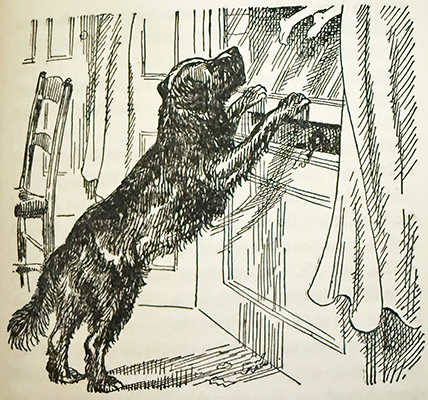 Unwin's illustrated Peter Pan was a Charles Scribner's Sons edition that stayed on American library shelves for decades. Library catalogs give a 1950 copyright, and the same plates appear unchanged from the 1951 release through the 1956 printing, so her Nana was drawn just before the Disney film.
Nora Spicer Unwin (1907–1982) was born in Surbiton, Surrey, into the publishing family behind Allen and Unwin. She trained at Leon Underwood's school, the Kingston School of Art and the Royal College of Art, and two of her wood engravings entered the British Museum while she was a student. She moved to the United States in 1946, following her friend and collaborator Elizabeth Yates, and illustrated Yates's Newbery Medal winner Amos Fortune, Free Man. She settled in Peterborough, New Hampshire, and is counted among the key figures of the twentieth-century wood-engraving revival. The engraver's habits show in this plate: tone is built from parallel, cut-like strokes rather than wash.
"Nana at the nursery window" Nana rears up with her forepaws on the sill and her head flung back, staring after the vanished children while the curtain blows in. It is the quietest version of the empty-nursery moment Bedford also chose, told entirely through the dog's body. The dense hatching gives her a dark coat broken only by highlights, so she reads as a black Newfoundland. Her structure is among the best of the mid-century artists: broad skull, heavy bone, thick feathered tail carried low. Unwin skips costume and comedy entirely. This is simply a big dog who knows something terrible has happened. Drawn two or three years before the Disney film, it is the last major Nana of the pre-Disney era, and its solid black coat anticipates the American editions that followed.
David Hall, Disney concept art (1939–1940)
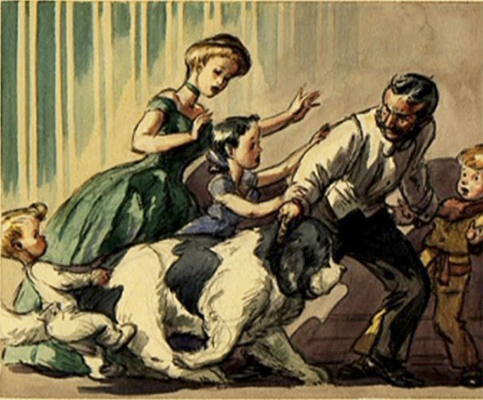 Hall was at Disney only from 1939 to 1940. He produced hundreds of paintings for Alice in Wonderland and a smaller number for Peter Pan. His Peter Pan paintings date to 1940 and have sold as major lots. The studio's own model sheets show "early design suggestions" for Nana from 1940. Early story plans had Nana flying to Neverland, chasing Tinker Bell and even narrating the film.
David S. Hall (1905–1964) was born in Northern Ireland and made his career as a Hollywood art director, with credits from 1928 into the 1960s and two Academy Award nominations for art direction, for Wee Willie Winkie (1937) and The Greatest Story Ever Told (1965). He spent only about fifteen months at Disney as an inspirational sketch artist but produced hundreds of pieces; the Walt Disney Family Museum notes that Peter Pan was where his imagination ranged most freely. His unused Alice paintings were finally published in 1986. A live-action art director's habits show in his Nana scene: a shallow stage, directional light and a crowd blocked like actors.
"Mr. Darling dragging Nana away" Hall paints the moment Mr. Darling hauls Nana off by the collar while Mrs. Darling and all three children cling to her, in loose, wet washes of muted green and brown. It is crowded, physical and genuinely upsetting, which fits the darker tone the Art of Disney blog attributes to his version . The composition reads like a film still: figures packed into a shallow stage, light falling from the left, every gesture pulling toward Nana. His Nana is white with grey-black patches and a dark head, still in Barrie's Landseer colours. The head is broad and heavily jowled, closer to a mastiff than a Newfoundland, but this is recognizably the stage tradition's dog, not yet Disney's later redesign."
The two Disney versions. A 2009 production history on The Art of Disney blog explains why Hall's Nana and the 1953 Nana are different animals. Walt first saw Peter Pan at age 12, when a touring company played Marceline in 1913. The studio bought the rights in 1939 and gave Hall, an English illustrator, the film's overall look. The blog describes Hall's watercolours as far darker than the play's atmosphere. The storyboard was nearly finished in 1941 when the war shut production down. When work resumed in 1947, Hall's version was shelved, Mary Blair took over art direction and Bill Peet's team rewrote the story.
 The two treatments produced two different Nanas. In Hall's darker, more Barrie-faithful version she was a major in Landseer colours. In Blair and Peet's lighter version she shrank to a nursery bookend and became a Saint Bernard. The Nana Walt saw as a boy in 1913 would almost certainly have been the stage tradition: an actor in a costume descended from Luath. By release, Nana was a reddish-brown and white Saint Bernard with blue eyes and a frilled nurse's cap. Norm Ferguson, Pluto's animator, handled her as a pantomime character who walks like a real dog.
Trina Schart Hyman, Peter Pan (Scribner, 1980)
Hyman's edition has recently been reissued as a Scribner Classics keepsake. Its black-and-white drawings were made in India ink with a fine No. 0 brush.
Trina Schart Hyman (1939–2004) was born in Philadelphia and studied there, at the Boston Museum School, and at the Swedish State Art School in Stockholm. She illustrated more than 150 books, became the first art director of Cricket magazine, and won the 1985 Caldecott Medal for Saint George and the Dragon along with three Caldecott Honors. She worked slowly and deliberately, taking about six months over the illustrations for each book. That patience shows in brushwork so fine it reads as pen.
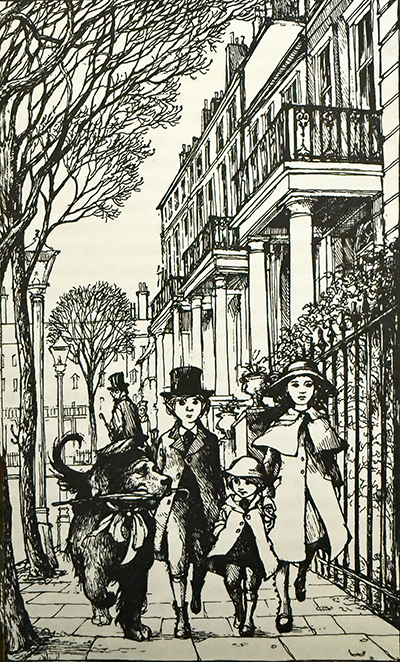
"The Walk to School" The street scene is a period set piece: a Georgian terrace with iron balconies, bare winter trees, gas lamps and John in a top hat. Nana leads the way with the umbrella crosswise in her mouth and a bow tied on her back, exactly as in Barrie's escort passage. Nana is solid black and very shaggy, with a heavy, almost bear-like head. Hyman captures her mass and devotion, but the breed's broad skull and clean outline are lost in the fur.
Greg Hildebrandt, Peter Pan (Unicorn Publishing House, 1987)
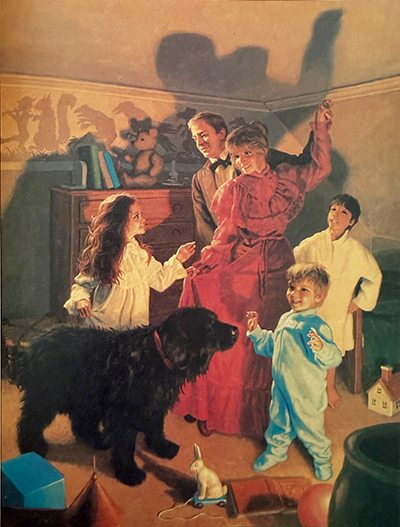 A large-format edition with full-page paintings in color and black and white.
Greg Hildebrandt (1939–2024) was born in Detroit and, with his identical twin Tim, worked as the Brothers Hildebrandt. Their Tolkien calendars of the 1970s were best-sellers, and in 1977 they painted a celebrated Star Wars poster on a deadline of days. In the 1980s Greg worked mostly on his own, chiefly on children's books, which is where this Peter Pan belongs. The fantasy-poster training shows in the dramatic, cinematic lighting.
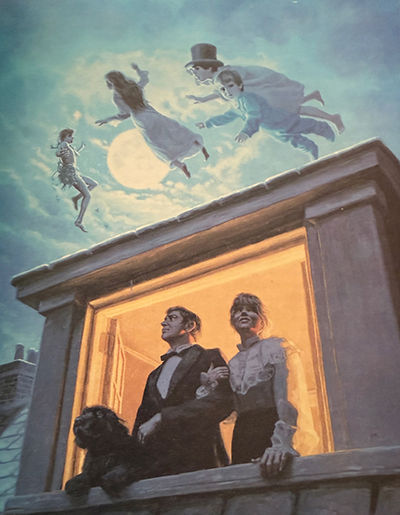
"The Nursery" and "The Flight" (pictured above) In the nursery painting, warm lamplight throws the family's shadows high on the wall above a frieze of piping, Pan-like silhouettes, while Mrs. Darling holds up Peter's captured shadow. Nana stands in the foreground: a solid black Newfoundland with a red collar, broad head and thick coat, the most breed-accurate painted Nana before Hutton's. In the flight painting, Hildebrandt invents a moment Barrie never wrote: Mr. and Mrs. Darling at the lit window, Nana's head on the sill, watching the children fly across the moon. In the novel the parents rush home too late. It is pure movie-poster drama, and in the dark Nana dissolves into a shapeless black mass. Like Disney, Hildebrandt makes Nana a family pet with no cap or uniform; unlike Disney, he keeps her a Newfoundland.
Anne Grahame Johnstone, Peter Pan and Wendy (Award Publications, 1988)
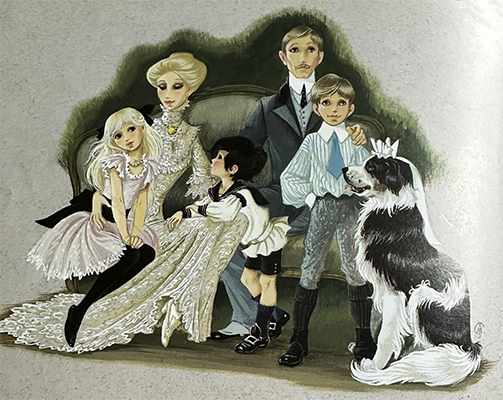 An adaptation by Jane Carruth for young children, reissued as recently as 2022. Anne and her twin Janet illustrated the original Hundred and One Dalmatians, and the division of labour matters: Janet was the animal painter, Anne the specialist in period costume. Janet died in 1979, before this edition.
Janet and Anne Grahame Johnstone were born on 1 June 1928, twin daughters of Doris Zinkeisen, a society portraitist and stage and film costume designer. They studied at St Martin's School of Art, and in 1956 Dodie Smith asked them to illustrate The Hundred and One Dalmatians, for which they drew Smith's own dogs from life. Their mother designed for Noël Coward, Irving Berlin and James Whale, and that theatrical costume sense passed directly to Anne. Janet died in a house fire in 1979. Anne then had to teach herself to draw and paint animals, her sister's specialty, and eventually became good enough to be elected to the Society of Equestrian Artists in 1998, the year she died. The 1988 Peter Pan catches her nine years into that self-education, which explains a lot about this Nana.
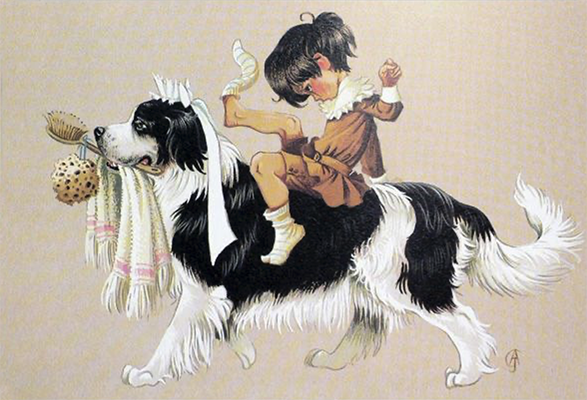
"Bath-time Ride" and "Family Portrait" Although published atfer the rise of Disney's influence, this Nana shows none of it. She is crisply black-and-white, wears a frilled cap tied with a ribbon, and in the first plate (shown above) trots off with a bath brush, sponge and towel in her mouth while Michael kicks on her back, a faithful staging of Barrie's bath-time. The costume work is the real achievement. In the family portrait, Mrs. Darling's lace gown, Michael's sailor suit and Mr. Darling's high collar are rendered with an expert's eye for Edwardian dress, exactly Anne's specialty. The dog is the weakest element. Nana is long-bodied, light-boned and narrow-muzzled, closer to a Border Collie than a Newfoundland, and in the portrait she barely reaches John's chest. A Newfoundland would loom over these children. It is hard not to read this as the missing hand of Janet, the twin who drew animals.
Raquel Jaramillo, Peter Pan (Simon and Schuster, 2000)
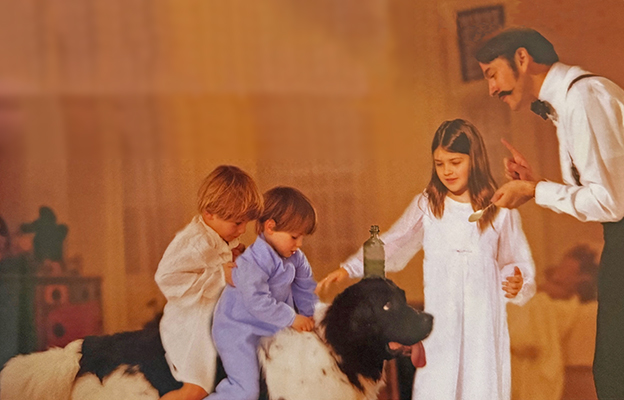 Billed by its publisher as the first photographically illustrated Peter Pan, it blends photography, illustration and digital work around the unabridged text.
Raquel Jaramillo was born in New York City in 1963 to Colombian immigrants and studied at Manhattan's High School of Art and Design. She worked as a designer and art director and illustrated children's books under her own name before becoming famous, as R. J. Palacio, for the novel Wonder.
"Be a man, Michael." Jaramillo stages the medicine scene with child actors in nightclothes, a mustached Mr. Darling with the spoon, and a real Landseer Newfoundland as Nana, the medicine bottle balanced on her head and her tongue lolling. The torn-paper edges and oversized pull quote make the spread feel like a scrapbook from a lost film. A live dog solves every anatomy problem the painters struggled with, and Jaramillo chose Luath's black-and-white coat. The cost is character: a real dog cannot act Barrie's primness, so this Nana is a patient, slightly bemused family dog rather than a disapproving nurse.
Robert Ingpen, Peter Pan and Wendy, Centenary Edition (2004)
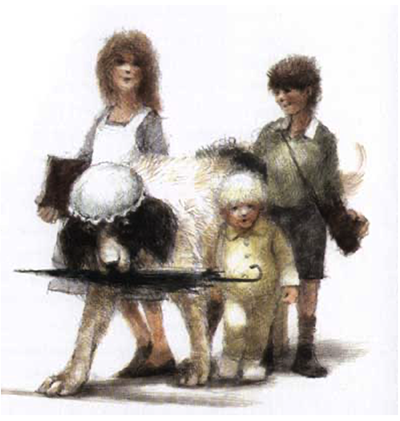 Over 70 illustrations for the unabridged text, published with Great Ormond Street Hospital. Ingpen bases characters on real figures, and his endpapers read as sketchbook pages trying out many possible Peters and pirates. One reviewer framed the edition as a corrective to "extreme disneyfication."
Robert Ingpen, one of Australia's most honoured illustrators, studied art and illustration at the Royal Melbourne Institute of Technology and has written or illustrated more than 100 books. In 1986 he became the only Australian to win the Hans Christian Andersen Medal for Illustration, and he received the Dromkeen Medal in 1989. He has also painted public murals, designed postage stamps, and designed the flag and coat of arms of the Northern Territory. He was appointed a Member of the Order of Australia in 2007. Fittingly, he first tried illustrating Peter Pan at the age of seven and kept those drawings.
"Nana Walking the Children to School" The most textually faithful image in the set. Ingpen picks Barrie's escort-to-school passage and includes its oddest detail, the umbrella carried crosswise in Nana's mouth in case of rain. His soft, smudged pencil-and-wash figures emerge from a bare white ground, giving the group a dreamlike, remembered quality. Nana is monumental, taller than Michael and nearly level with Wendy, which is right for a Newfoundland and for her authority. The color is Landseer. The frilled nurse's cap is also worth noting. It is a stage and Disney convention rather than something the novel describes, so even this "corrective" edition carries a trace of the film.
Ingpen in translation. Ana Nebreda's 2011 review of the Spanish edition of Ingpen's book on the children's-literature blog Biblioabrazo describes Nana plainly as una perra terranova, a female Newfoundland, found in Kensington Gardens and more meticulous with the children than any human nanny. Nebreda reads the Darling household as Barrie's irony at work: perfect respectability on the surface, a dog running the nursery underneath. She also warns that so many versions now exist that readers must set aside their childhood imagery to meet the original fresh. That is exactly the problem Nana faces: the Disney image arrives before the text does.
Renae De Liz and Ray Dillon, Peter Pan graphic novel, Vol. 1 (2013)
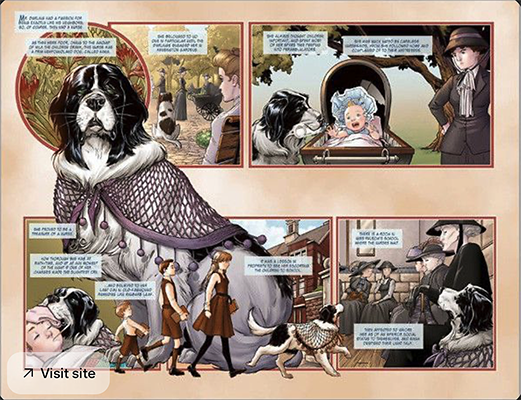 Kickstarter-funded, covering the first third of the novel. De Liz stated her goal as an adaptation as true to the source as possible. She also rejected Disney's Tinker Bell in favor of Barrie's.
Renae De Liz was born in Alaska in 1982, grew up on the West Coast and lives in Maine. She broke into comics in 2007 drawing IDW's Rogue Angel, then founded Womanthology, an anthology of women creators whose Kickstarter raised more than four times its goal. She drew the New York Times bestselling comics adaptation of The Last Unicorn and wrote and drew the Eisner-nominated Legend of Wonder Woman. Her husband and longtime collaborator, Ray Dillon, inks, colours and letters her work; they met at San Diego Comic-Con. Her experience adapting a beloved literary fantasy and drawing period settings shows in how closely her pages track Barrie's text.
Nana's introduction spread. A strong breed likeness, second only to Hutton's, and the richest reading of Barrie's satire. The captions quote Barrie's text directly, and the panels act out each clause: Nana peering into prams in Kensington Gardens, a careless nursemaid glaring in the background, Nana asleep beside a sick child, the walk to school, and the basement waiting room where the human nurses turn their noses up at her. The opening portrait sets Nana in an Art Nouveau roundel like a Mucha saint, with a broad head, dense black-and-white coat and real Newfoundland mass. Swapping Disney's cap for a crocheted purple shawl with pom-poms is an inspired costume choice: Edwardian, homely, and entirely her own.
Steve Hutton, Peter Pan and Wendy, Books Illustrated limited edition (2015)
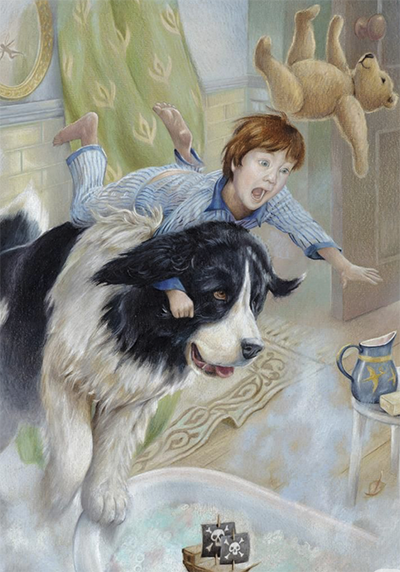 Hutton's originals were drawn in colored pencil on paper, at 18 × 12 inches, for a limited edition from Books Illustrated Ltd that has since sold out.
Steve Hutton was born in Yorkshire in 1970 and grew up near Leeds. He earned a BA in 1992 and an MA in graphics and illustration in 1998, illustrated children's books for Oxford University Press, and has run illustration workshops in schools across the UK. He has since written and illustrated the Raven's Wand fantasy novels and companion oracle decks. Years of drawing for children, in a medium that rewards patience, account for both the precision of the dog and the playfulness of the scene.
"I won't be bathed, I won't, I won't!" The title is Michael's protest from Chapter 2, and the gallery sums up the scene as Nana getting the boys to the bath. Hutton shows Michael launched off Nana's back toward the tub, a teddy bear airborne, a toy pirate ship floating in the water and a tiny fairy in the mirror. It is the most anatomically convincing Newfoundland of all: broad skull, short muzzle, small ears, amber eye, heavy bone, Landseer coat. That precision is remarkable in coloured pencil, a slow medium that rewards Hutton's attention to coat texture. His near-photographic realism is the opposite of Hudson's stylization, and it pays off: this is a Nana a Newfoundland breeder would recognize on sight. The pirate ship and fairy foreshadow Neverland neatly. The trade-off is that his Nana is purely a big, happy family dog, with no cap or costume and no sense of her as Barrie's prim professional. Hutton gets the breed exactly and the character only partly.
Beautifully illustrated stories appeal to children and collectors. Clicking each link below will allow you to purchase the book through Amazon.com, commissions earned from each sale benefit the NCA Newfoundland Health Challenge and the NCA National Newfoundland Rescue Network.


